- wisetech
Uncategorized
Share on:-
Share on:-
Many healthcare providers invest in new software hoping to improve efficiency.
A scheduling platform here.
A patient communication tool there.
A separate billing solution.
An independent reporting dashboard.
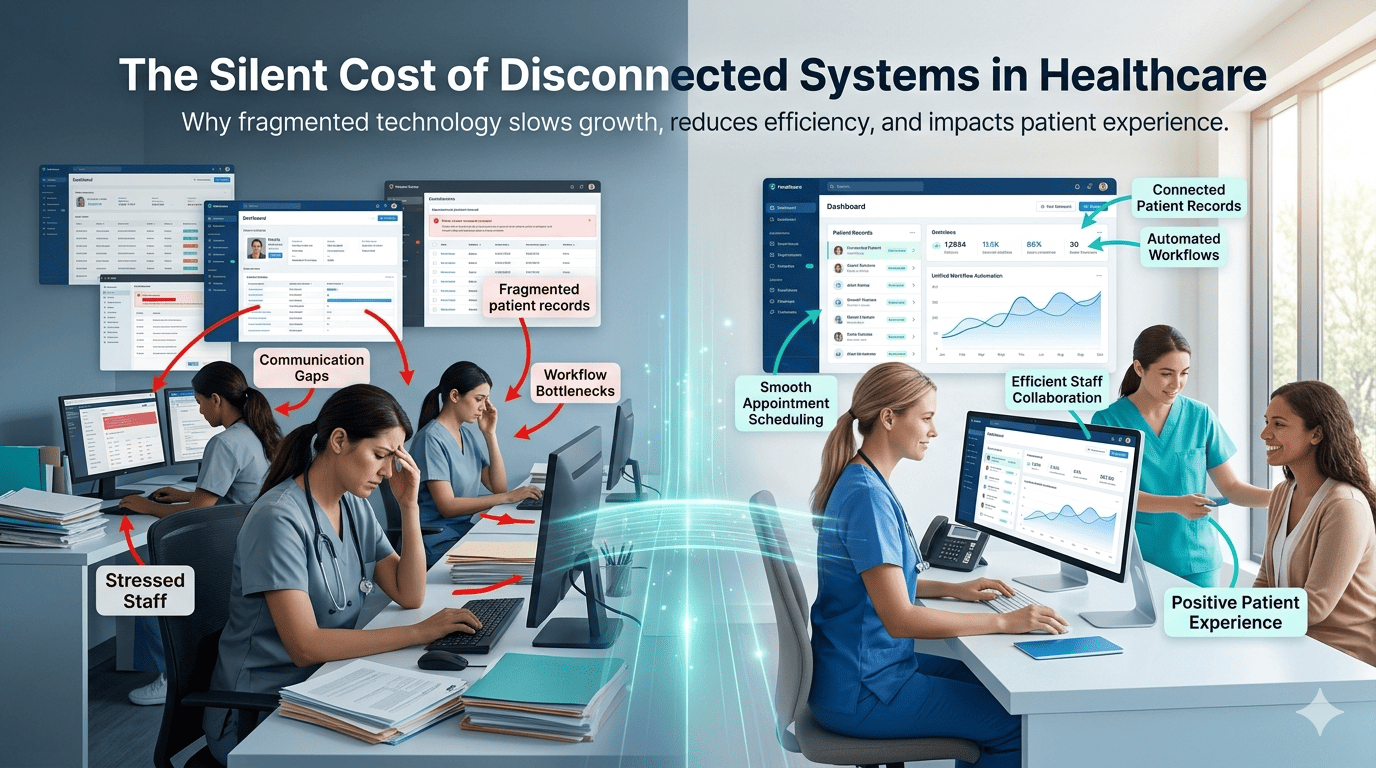
At first, these tools appear to solve individual problems. However, the silent cost of disconnected systems in healthcare often becomes visible only when clinics begin experiencing operational friction, staff burnout, and patient dissatisfaction.
The issue is rarely a lack of technology.
The issue is technology that doesn’t work together.
Unlike equipment failures or staffing shortages, disconnected systems create gradual problems.
The impact accumulates through:
Because these costs develop slowly, many clinics underestimate their effect on overall performance.
Healthcare interoperability resources:
https://www.himss.org
When information is scattered across multiple platforms, employees spend valuable time:
Instead of focusing on patients, staff become process managers.
Over time, this contributes to lower productivity and increased burnout.
Patients expect healthcare interactions to be simple and seamless.
Unfortunately, disconnected systems often create fragmented experiences.
Examples include:
These friction points may appear small individually, but collectively they affect patient satisfaction and trust.
Healthcare organizations depend on accurate information to make informed decisions.
When systems fail to communicate effectively, clinics often experience:
As a result, leadership teams spend more time validating information and less time improving operations.
Many clinics discover operational weaknesses when they begin growing.
As patient volumes increase:
Disconnected platforms often struggle to support expansion.
Instead of enabling growth, they create additional complexity.
The silent cost of disconnected systems is not limited to efficiency.
It also affects revenue.
Operational inefficiencies can contribute to:
These hidden expenses can significantly affect long-term profitability.
Healthcare digital transformation insights:
https://www.healthit.gov
Successful healthcare organizations increasingly focus on integration rather than accumulation.
Instead of continuously adding software, they create connected systems that allow information to flow automatically.
Benefits include:
✔ Improved staff productivity
✔ Better patient experiences
✔ More accurate reporting
✔ Reduced operational complexity
✔ Greater scalability
The goal is not fewer tools.
The goal is technology that works together.
The biggest threat posed by disconnected systems is that their costs are often invisible until they become significant.
By identifying inefficiencies early and building integrated workflows, healthcare organizations can improve operational performance, support sustainable growth, and deliver better patient experiences.
In healthcare, efficiency is not simply about having technology.
It is about having connected technology.
At WiseTech Informatics, we are always open for business. If you are looking for a reliable web development company, we are always available. You can reach us via any of our contact channels today to book an appointment.