- wisetech
Uncategorized
Share on:-

Share on:-
As healthcare organizations grow, technology often becomes either their greatest asset or their biggest obstacle.
A platform that works for one doctor and a few hundred patients may struggle when supporting multiple providers, locations, services, and thousands of patient interactions.
That is why understanding the scalability principles every healthcare platform must follow is critical for long-term success.
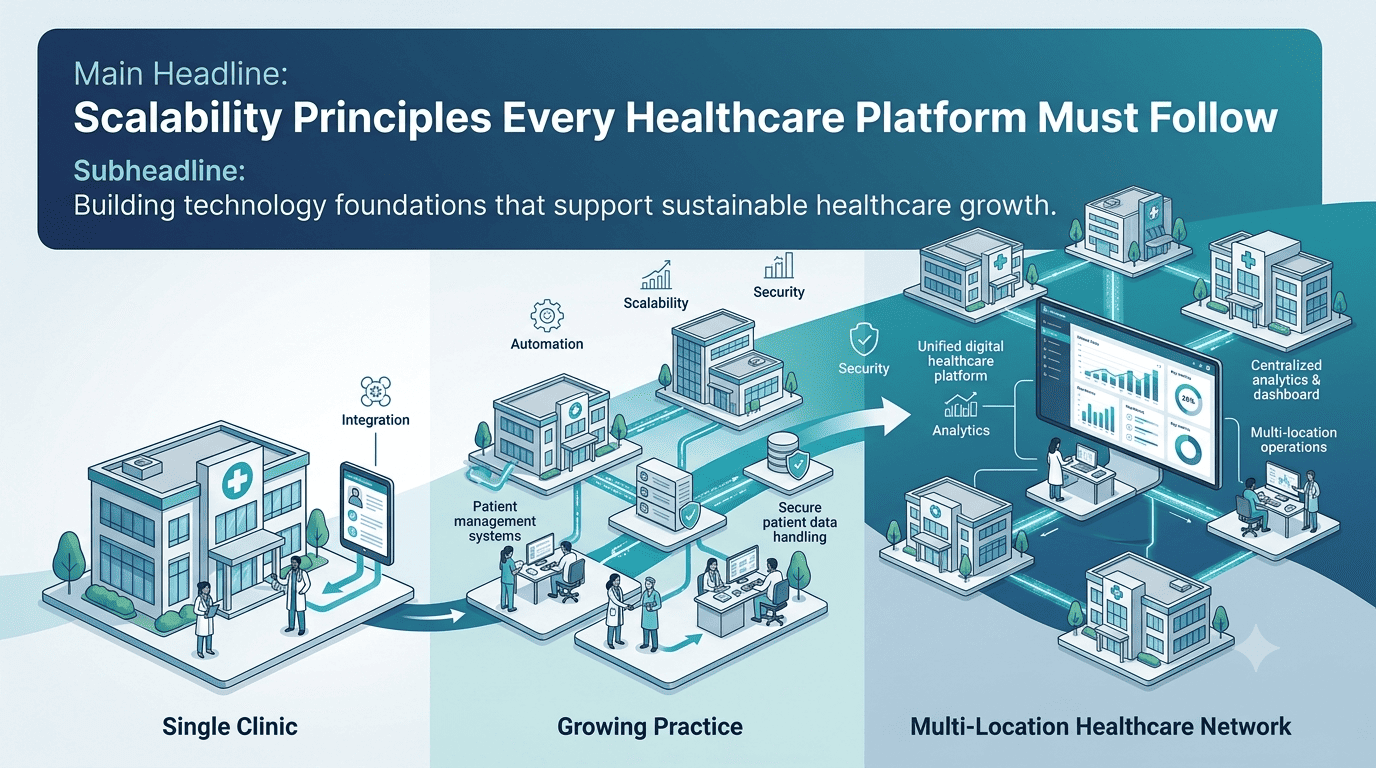
Scalability is not simply about handling more users. It is about maintaining efficiency, reliability, security, and patient experience as the organization grows.
Healthcare growth introduces new challenges:
Without a scalable platform, these changes often lead to inefficiencies, operational bottlenecks, and declining patient experiences.
One of the most important scalability principles is integration.
Healthcare platforms should seamlessly connect:
When systems communicate effectively, organizations avoid duplicate work and improve operational visibility.
Growth naturally increases administrative workload.
Future-ready platforms should automate:
Automation allows healthcare teams to scale operations without proportionally increasing administrative burden.
A scalable platform should perform reliably whether it supports:
Slow response times and system instability often become major barriers to growth.
Performance should remain predictable as demand increases.
Healthcare organizations often expand into multiple locations.
A scalable platform should enable:
This allows growth without creating operational fragmentation.
Growth generates more information.
Therefore, healthcare platforms must provide:
Accurate information improves decision-making and operational efficiency.
Healthcare organizations evolve.
New services, specialties, workflows, and regulations emerge over time.
Scalable platforms should adapt without requiring complete system replacements.
Flexibility protects long-term technology investments.
As patient volumes increase, security requirements become even more important.
Scalable healthcare platforms should include:
Growth should never compromise patient trust.
Patients expect convenience regardless of clinic size.
A scalable platform should support:
Patient experience must scale alongside operations.
Successful healthcare organizations do not wait until growth creates problems.
They build scalable foundations from the beginning.
By focusing on integration, automation, performance, flexibility, security, and patient experience, healthcare providers can create platforms that support sustainable expansion and operational excellence.
Growth becomes significantly easier when technology is designed to grow with the organization.
At WiseTech Informatics, we are always open for business. If you are looking for a reliable web development company, we are always available. You can reach us via any of our contact channels today to book an appointment.