- wisetech
Uncategorized
Share on:-

Share on:-
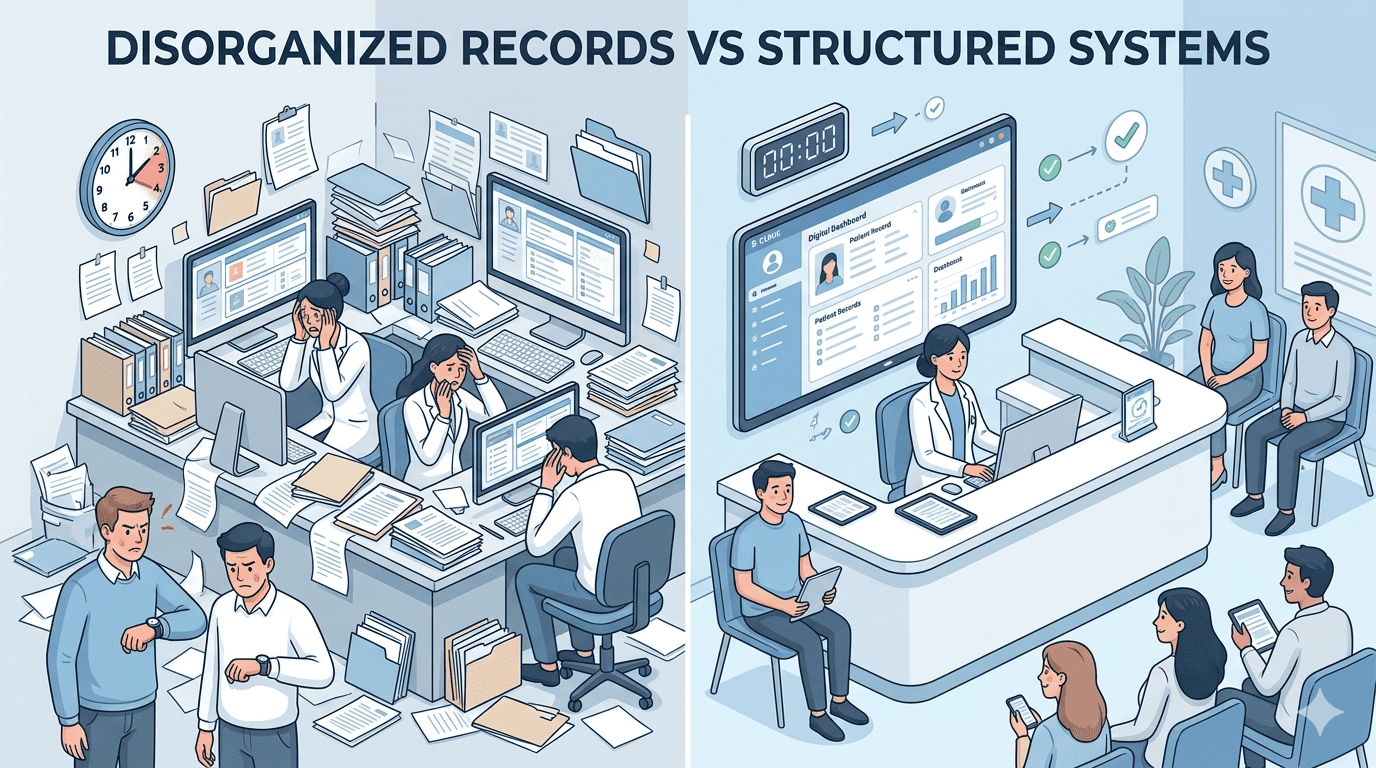
Disorganized patient records may seem like a minor administrative issue. However, over time, they create serious operational and clinical challenges. As a result, both efficiency and patient experience suffer.
When patient information is scattered, duplicated, or outdated, healthcare providers struggle to deliver timely and accurate care.
First, staff members spend unnecessary time searching for patient information. Consequently, appointments slow down and workflows become inefficient.
For example, missing or incomplete records force teams to repeat data collection. In addition, manual verification increases workload.
According to the World Health Organization (WHO), efficient health information systems are essential for timely and safe care.
Therefore, poor record organization directly leads to delays.
In addition to delays, disorganized patient records increase the risk of errors.
When multiple versions of the same data exist, confusion becomes unavoidable. Moreover, outdated information may influence incorrect decisions.
Research from the National Institutes of Health highlights that incomplete or inaccurate patient data significantly increases clinical risk.
Because healthcare decisions depend on accurate data, even small inconsistencies can lead to serious consequences.
Patients may not see internal systems directly. However, they experience the outcomes.
For instance:
As a result, frustration increases. Furthermore, trust begins to decline.
Beyond daily operations, poor record management impacts long-term growth.
When systems lack structure:
Consequently, scaling operations becomes difficult.
To solve these challenges, clinics must implement structured digital systems.
These systems provide:
In addition, integrated platforms improve communication across teams. Therefore, both efficiency and patient satisfaction increase.
Disorganized patient records are not just an administrative inconvenience. Instead, they directly affect care quality, operational efficiency, and patient trust.
By organizing and centralizing data, healthcare providers can reduce delays, minimize errors, and improve overall experience.
In modern healthcare, structured systems are essential for delivering reliable and efficient care.
At WiseTech Informatics, we are always open for business. If you are looking for a reliable web development company, we are always available. You can reach us via any of our contact channels today to book an appointment.