- wisetech
Uncategorized
Share on:-
Share on:-
Healthcare providers enter medicine to care for patients—not to spend their days managing paperwork, coordinating appointments, chasing records, or handling repetitive administrative tasks.
Yet many clinics still rely heavily on manual processes that consume valuable time and create operational bottlenecks.
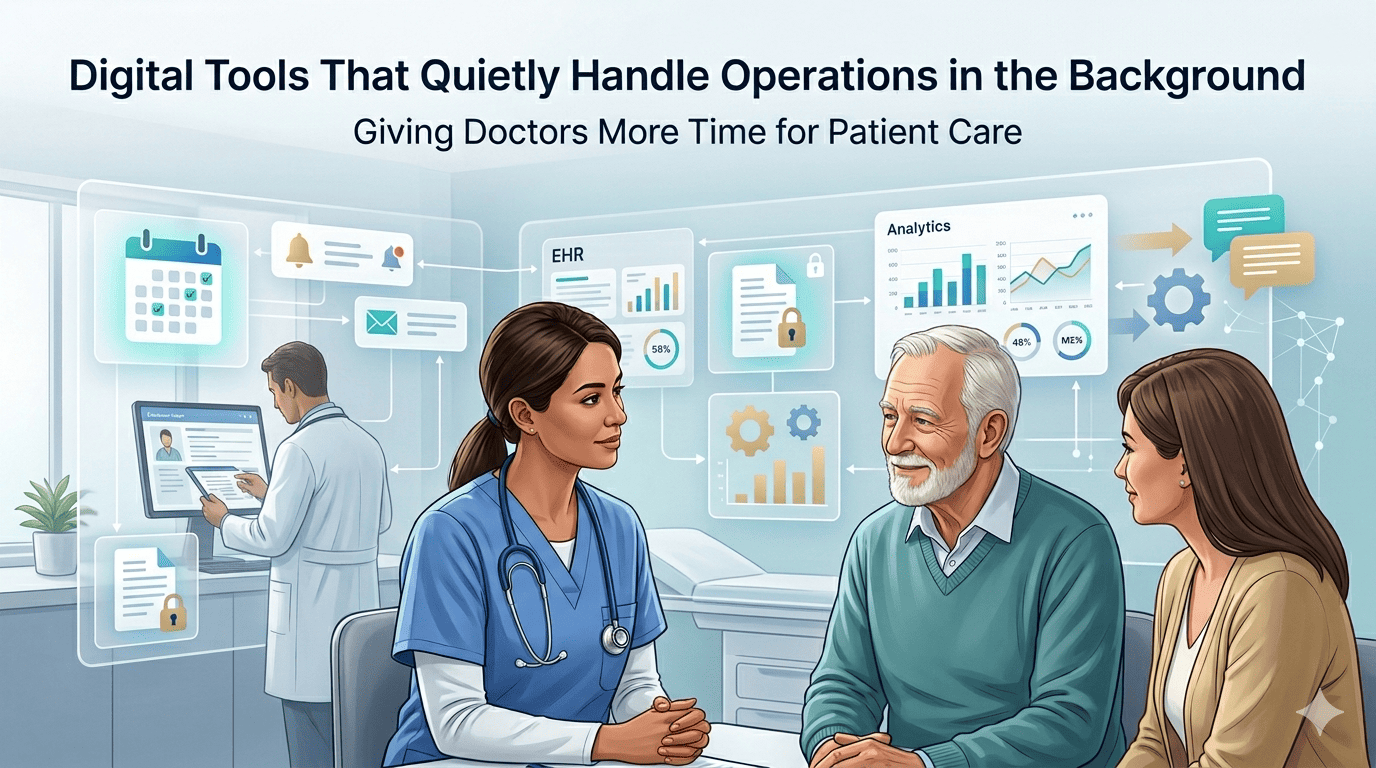
Fortunately, modern digital tools can quietly handle many of these operational responsibilities in the background. When implemented correctly, they allow doctors and staff to focus more on patient care while improving efficiency across the organization.
Every minute spent on repetitive administration is a minute not spent improving patient outcomes.
Manual processes often lead to:
Therefore, clinics that automate routine operations often experience smoother workflows and better patient experiences.
One of the most impactful tools is automated appointment scheduling.
These systems allow patients to:
As a result, front-desk workload decreases while patient convenience improves.
Communication tools can automatically manage:
Consequently, clinics reduce missed appointments and improve engagement without requiring constant manual outreach.
Modern EHR platforms centralize patient information and eliminate the need to search through multiple files and systems.
Benefits include:
Therefore, doctors spend less time locating information and more time treating patients.
Workflow automation platforms can handle repetitive operational tasks such as:
As a result, operational consistency improves across the clinic.
Many healthcare providers make decisions based on assumptions rather than data.
Analytics tools help clinics track:
Consequently, leadership teams gain visibility without manually compiling reports.
Digital intake forms allow patients to submit information before arriving.
This reduces:
At the same time, patient records become easier to manage and access.
Integrated systems connect multiple functions:
When systems communicate effectively, clinics avoid duplicate work and improve overall efficiency.
The best healthcare technology often works quietly in the background.
Digital tools that automate scheduling, communication, patient intake, reporting, and workflow management help clinics reduce administrative burden and improve operational efficiency.
Most importantly, they allow doctors to spend more time where they create the greatest value: caring for patients.
At WiseTech Informatics, we are always open for business. If you are looking for a reliable web development company, we are always available. You can reach us via any of our contact channels today to book an appointment.