- wisetech
Uncategorized
Share on:-
Share on:-
Modern healthcare environments depend on speed, accuracy, and continuity. Yet many clinics still operate with fragmented systems that prevent information from flowing smoothly across departments.
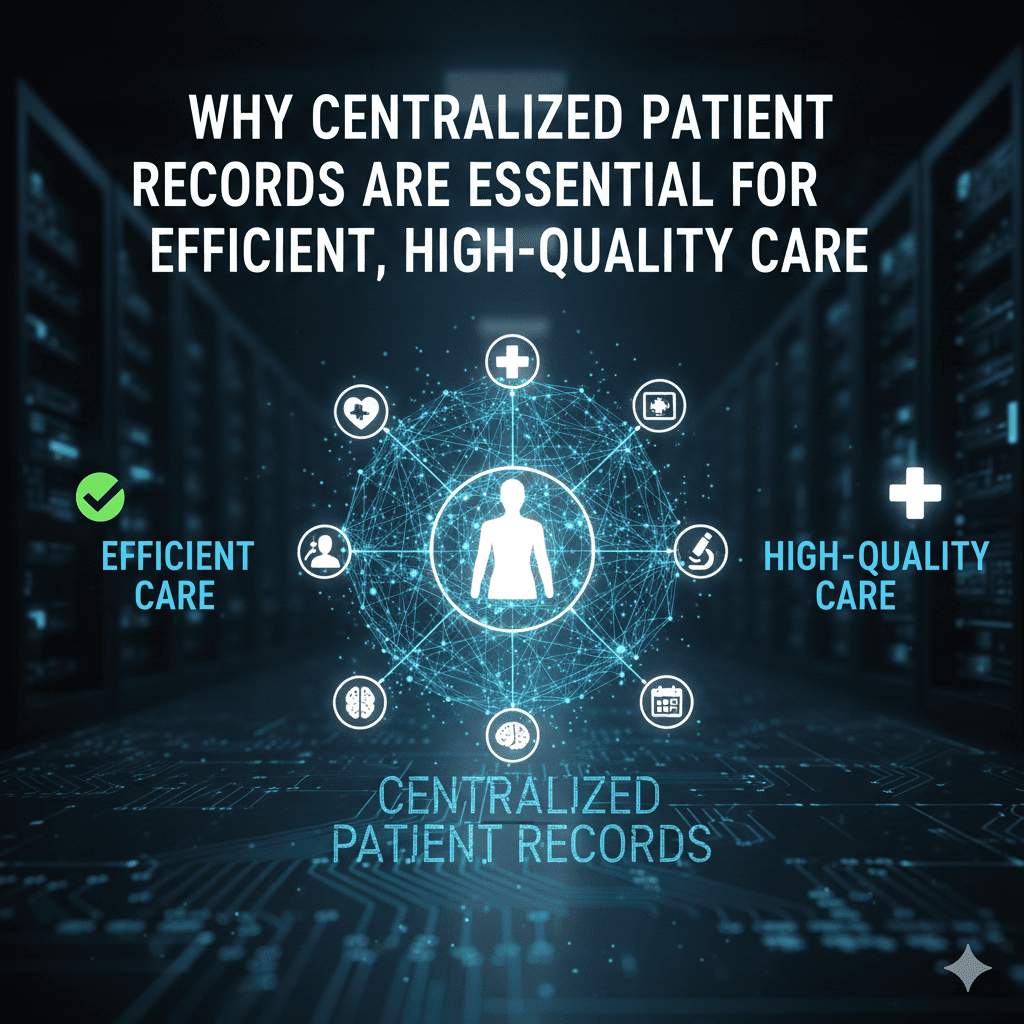
Centralized patient records solve this problem by creating a unified, accessible source of truth for clinical and administrative teams.
When healthcare data is consolidated into a secure, interoperable system, both patient experience and operational efficiency improve measurably.
Disconnected platforms force staff to switch between EHRs, billing tools, lab portals, and paper files. This fragmentation leads to:
Delayed consultations
Duplicate data entry
Increased documentation errors
Poor coordination between departments
Without an integrated record system, clinicians lack full visibility into patient history. This impacts decision-making and reduces care quality.
Healthcare systems must move from siloed data environments toward unified record management.
When medical information follows the patient throughout their care journey, clinics achieve:
Faster check-ins
Reduced repetitive form filling
Accurate treatment histories
Smoother referrals
Patients no longer feel like they are “starting over” at every appointment. Instead, they experience continuity.
For example, interoperability standards promoted by organizations like Health Level Seven International support structured data exchange between systems.
Additionally, regulatory frameworks such as Health Insurance Portability and Accountability Act ensure that centralized systems remain secure and compliant.
Beyond patient satisfaction, centralized data architecture drives measurable operational gains.
Clinics benefit from:
Real-time reporting dashboards
Reduced administrative workload
Automated documentation workflows
Improved cross-team coordination
Integrated systems also strengthen compliance with global privacy standards such as the General Data Protection Regulation.
When leadership can access unified analytics, strategic decisions become data-driven rather than reactive.
If you’re evaluating digital transformation initiatives, explore our guide on Digital Healthcare Integration Strategies and our resource on Improving Clinic Workflow Efficiency.
High-quality healthcare is not just clinical expertise — it is also information accessibility.
A unified patient record system ensures:
Complete clinical histories
Reduced medical errors
Faster diagnosis
Coordinated treatment plans
According to the World Health Organization, digital health integration plays a critical role in improving healthcare system performance globally.
Centralization does not mean reduced security. It means controlled, encrypted, and permission-based access to the right data at the right time.
Efficient, high-quality care requires more than skilled providers. It requires connected systems.
Centralized patient records:
Improve care continuity
Enhance operational efficiency
Strengthen regulatory compliance
Enable scalable healthcare delivery
Healthcare organizations that modernize their information architecture today position themselves for sustainable growth tomorrow.
At WiseTech Informatics, we are always open for business. If you are looking for a reliable web development company, we are always available. You can reach us via any of our contact channels today to book an appointment.