- wisetech
Uncategorized
Share on:-
Share on:-
When a healthcare organization expands from one clinic to several locations, operational complexity increases quickly.
As a result, the natural response is often:
“We need more people.”
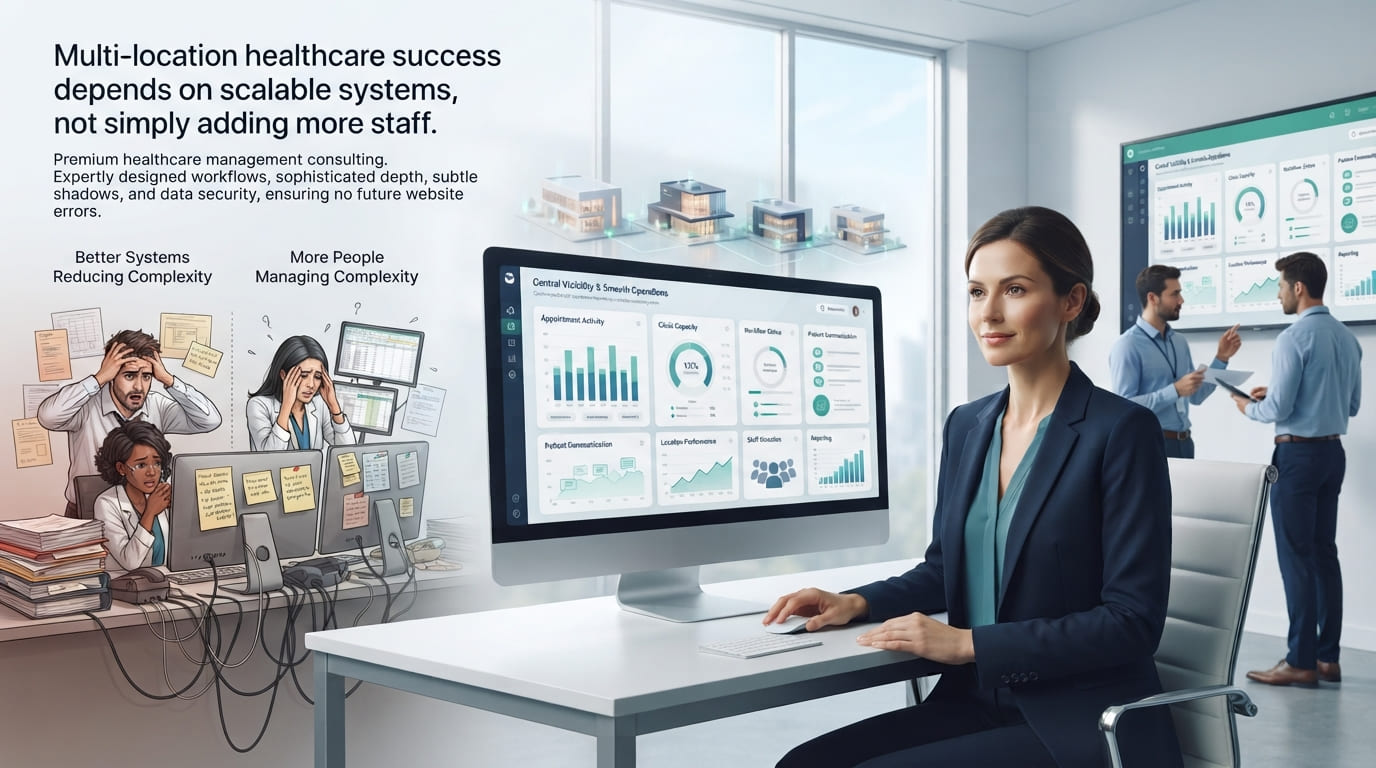
More administrators, coordinators, and managers may certainly be necessary as patient volume increases. However, simply increasing headcount doesn’t automatically create efficient operations.
There is a bigger truth:
Multi-location success depends heavily on the systems those people operate within.
Without strong multi-location clinic systems, adding staff can introduce another layer of coordination to already inefficient operations. Therefore, scalable growth requires people and systems to work together.
Staff remain essential. Nevertheless, the operational infrastructure surrounding them determines how effectively they can perform as the organization expands.
Consider a simple administrative process that requires five people:
Reception → Coordinator → Administrator → Billing → Manager
If several handoffs exist because responsibilities are unclear or systems don’t communicate, hiring another coordinator is unlikely to solve the underlying problem.
Instead, it may create six people managing the same inefficient workflow.
Before increasing headcount, examine the process carefully.
For example, consider:
First, identify unnecessary work. Then simplify the process. Finally, determine whether additional staffing or technology is actually required.
Consequently, employees can spend more time on responsibilities that genuinely require their expertise.
Imagine three clinics handling the same patient process in three different ways.
Clinic A: Online booking → digital registration → consultation → automated follow-up
Clinic B: Phone booking → paper form → manual data entry → manual follow-up
Clinic C: Online inquiry → staff callback → spreadsheet → separate billing process
Individually, all three approaches may function. However, managing them as one organization becomes significantly harder.
For this reason, strong multi-location clinic systems should establish standardized core workflows for areas such as:
Standardization doesn’t mean every branch must operate identically. Instead, critical processes should have enough consistency to be measured, managed, improved, and scaled.
At the same time, locations can retain flexibility where local circumstances genuinely require it.
As locations multiply, leadership cannot depend entirely on phone calls, spreadsheets, chat messages, and manually prepared reports.
Instead, decision-makers need appropriate visibility into areas such as:
With centralized reporting, leadership can identify patterns across the organization. Furthermore, managers can compare locations without treating each branch as a separate information island.
As a result, decisions can be based on consistent information rather than fragmented updates.
For broader guidance on healthcare information technology and interoperability, organizations can consult resources from HealthIT.gov:
Disconnected tools may seem manageable with one location. However, the same fragmentation becomes increasingly difficult as additional clinics open.
For instance, different branches may use separate tools for:
Consequently, staff may spend increasing amounts of time transferring information between systems instead of using that information productively.
A more scalable technology architecture should create appropriate connections between:
Patient Acquisition → Booking → Patient Information → Communication → Billing → Reporting
Importantly, this doesn’t necessarily mean putting everything into one application.
Instead, the goal is to ensure that necessary systems work together effectively. As a result, employees can spend less time moving information manually between disconnected platforms.
Every growing organization has experienced some version of:
“Ask that person—they’re the only one who knows how it works.”
Initially, this may seem manageable. However, it becomes increasingly risky when an organization operates multiple locations.
For example, what happens if that employee:
Therefore, important operational knowledge should exist within documented processes and systems rather than only inside individual employees’ heads.
To reduce dependency, organizations can establish:
People remain essential. At the same time, operations should not depend completely on one specific employee being available.
The idea that systems matter more than staff should never be interpreted as:
“People don’t matter.”
In fact, the opposite is closer to the truth.
Strong systems make it easier for good people to do good work.
For example, staff shouldn’t have to spend significant portions of their day:
By reducing operational friction, better systems can give teams more capacity to focus on patients and higher-value responsibilities.
Moreover, employees can work with greater clarity when processes and responsibilities are properly defined.
Therefore, workflow design should be considered alongside technology implementation.
Opening another clinic doesn’t simply add another address.
Instead, it adds:
More patients
If the organization already depends heavily on manual coordination, expansion can amplify existing weaknesses.
Therefore, before adding another location, assess whether the current infrastructure can support it.
Consider the following areas:
Processes: Are critical workflows documented and repeatable?
Technology: Can existing platforms support additional locations and users?
Information: Can necessary information move appropriately across the organization?
Management: Can leaders monitor operations without manually chasing updates?
Staffing: Are responsibilities and decision rights clearly defined?
Patient Experience: Can core service standards remain consistent?
Growth: Can your patient acquisition model be replicated in the new market?
By answering these questions before expansion, organizations can identify scalability gaps earlier. Consequently, problems can be addressed before they multiply across additional locations.
One mistake organizations can make is assuming that multi-location standardization means headquarters should control every decision.
However, excessive centralization can create another bottleneck.
A more useful principle is:
For example, organization-wide reporting, technology standards, security policies, brand standards, and strategic oversight may benefit from centralized management.
Similarly, core workflows, service expectations, documentation processes, and measurement frameworks may benefit from common standards.
Meanwhile, staff scheduling, community engagement, local marketing, and certain operational decisions may require location-level flexibility.
Ultimately, successful multi-location clinic systems balance organizational consistency with appropriate local autonomy.
A common growth pattern looks like this:
Open location → encounter complexity → add staff → add software → create workaround → repeat
Unfortunately, this creates reactive growth.
A more scalable approach is:
Audit → Standardize → Integrate → Document → Measure → Expand
First, audit existing operations. Next, identify processes that need standardization. Afterward, connect appropriate systems and document critical workflows. Finally, measure the results before repeating the model at another location.
By following this approach, each new clinic can begin with a stronger operational foundation.
If every new location requires reinventing workflows, technology, reporting, and responsibilities, the operating model isn’t truly scalable yet.
A scalable healthcare organization can evaluate seven operational foundations.
Leadership should be able to understand relevant performance across locations. Therefore, reporting should provide appropriate organization-wide visibility.
Critical processes should be documented and repeatable. As a result, each location doesn’t need to reinvent routine operations.
Necessary information should move appropriately between systems. Consequently, employees can spend less time on unnecessary manual transfers.
Employees should understand responsibilities, decisions, and escalation paths. In turn, this can reduce unnecessary coordination.
Core service standards should remain recognizable across locations. At the same time, appropriate local flexibility can be maintained.
Locations should use consistent metrics. Therefore, leadership can make more meaningful comparisons across the organization.
Technology and processes should accommodate future locations without unnecessary reinvention. Ultimately, the infrastructure should make expansion easier rather than progressively more complicated.
Organizations handling health information should also evaluate applicable privacy and security requirements as systems expand.
U.S. organizations, for example, can review healthcare security guidance published by the U.S. Department of Health and Human Services:
Hiring talented people remains fundamental to healthcare growth.
However, even excellent employees can struggle inside fragmented operations.
As each new location opens, increasing coordination, manual work, management requirements, and workarounds can make growth progressively harder.
By contrast, strong multi-location clinic systems provide standardized processes, connected technology, clear responsibilities, and centralized visibility.
This creates an important shift:
Instead of people constantly holding the operation together, well-designed systems help teams run it effectively.
As a result, staff can focus more attention on responsibilities where their judgment, expertise, and patient interaction matter most.
Before investing in another branch, ask one question:
The answer can reveal where your next investment should go.
For instance, the constraint may be staffing. Alternatively, the problem may involve:
Once the bottlenecks are understood, investments can be prioritized more effectively.
At WiseTech Informatics, we help healthcare businesses evaluate and improve the digital systems, websites, applications, and technology infrastructure supporting their growth.
Rather than simply adding more technology, the objective is to build a stronger digital foundation for the organization you are becoming.
Multi-location success isn’t created by choosing between people and technology.
Instead, sustainable expansion comes from designing an environment where both can scale together.
People deliver the work.
Processes define how the work happens.
Technology supports the process.
Systems make the operating model repeatable.
When these foundations work together, adding another location doesn’t have to mean multiplying operational complexity.
Ultimately, the principle is simple:
Don’t just staff for growth. Build systems for it.
At WiseTech Informatics, we are always open for business. If you are looking for a reliable web development company, we are always available. You can reach us via any of our contact channels today to book an appointment.